

US Italy Cross-Border Law Firm: Navigating Legal Complexity in 2026
- Gianni Mendes Toniutti, Esq.

- 2 minutes ago
- 11 min read
In 2026, the distance between an American boardroom and the Italian coastline is no longer measured in miles, but in the precision of your legal architecture. Securing a US Italy cross-border law firm that understands the delicate balance between common law and civil systems is the vital first step toward resolving the friction of conflicting jurisdictions. You've likely felt the weight of potential visa denials or the complexity of corporate non-compliance. These aren't just legal hurdles; they're obstacles to the global legacy you're building.
You'll gain a master framework that secures your residency and protects your cross-border investments with surgical precision. This article previews the essential strategies for successful E-2 and O-1 visa acquisitions alongside the seamless transition of business operations. We'll also explore the critical 2026 updates, including the impacts of the Tajani Law on citizenship and the evolving requirements for international litigation in a shifting regulatory environment. By aligning your personal mobility with a sophisticated corporate structure, you can ensure your international expansion is both legally sound and future-proof.
Table of Contents
Navigating the Legal Bridge Between the United States and Italy
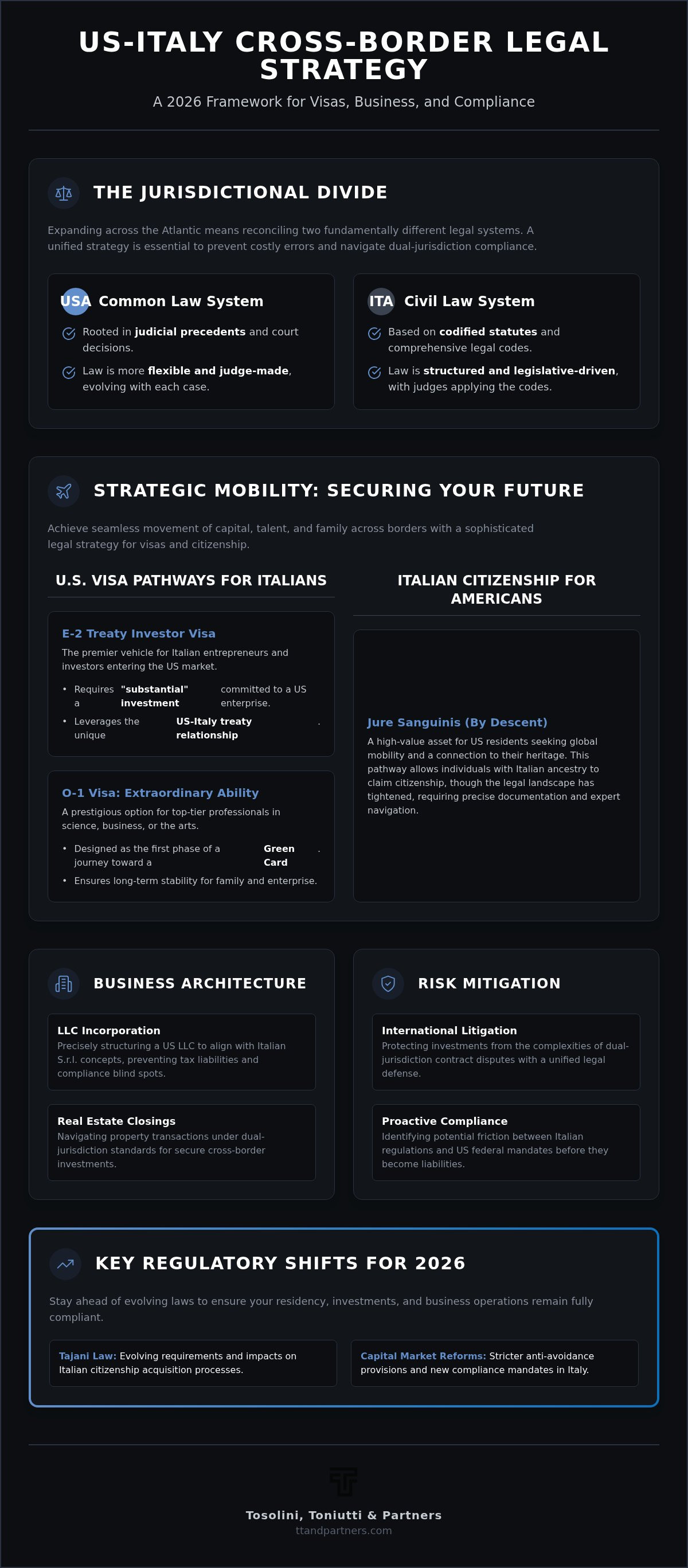
Expanding a legacy across the Atlantic requires more than just ambition; it demands a structural blueprint that reconciles two divergent legal worlds. Italy’s civil law system, rooted in codified statutes, often clashes with the American common law tradition where judicial precedents carry the weight of law. A specialized US Italy cross-border law firm serves as the architect of this transition, ensuring that your strategic goals aren't lost in the friction between these systems. We don't just provide advice; we design the legal framework that supports your growth.
Relying on separate local firms often creates a fragmented defense. An Italian firm might optimize for local tax codes without realizing those choices trigger reporting requirements or tax liabilities under US federal law. A unified approach treats mobility, corporate architecture, and dispute resolution as a single, cohesive ecosystem. This alignment is rooted in the long-standing history of Italy-United States relations, which provides the diplomatic and economic bedrock for modern cross-border ventures.
The Complexity of Dual-Jurisdiction Compliance
Friction arises when Italian regulatory expectations meet US federal mandates. In 2026, the landscape has shifted with new capital market reforms and stricter anti-avoidance provisions in Italy. Partnering with a US Italy cross-border law firm ensures you aren't caught off guard by these changes. We eliminate "legal translation" errors; these are fundamental misunderstandings of how a Permesso di Soggiorno interacts with a US Green Card or how an Italian S.r.l. translates into an American LLC structure. We identify these blind spots before they become liabilities.
Why National Expertise Matters for Global Clients
Our reach extends across the entire United States, providing a consistent standard of excellence regardless of where your business lands. We adopt a boutique approach because high-stakes legal matters deserve direct access to senior counsel, not a revolving door of associates. This "Bridge" philosophy connects the heritage of Italian craftsmanship and industry with the vast scale of American opportunity. It’s about creating a seamless path where your intellectual and financial capital can thrive without borders. If you're ready to secure your international future, you can contact our team to begin the journey.
Strategic Mobility: Securing Visas and Italian Citizenship
Strategic mobility is the cornerstone of a successful transatlantic life. It’s the ability to move capital, talent, and families across borders without the friction of bureaucratic delay. A specialized US Italy cross-border law firm provides the intellectual framework necessary to navigate these complex pathways. Whether you’re an entrepreneur launching a venture in New York or a professional reclaiming your heritage in Rome, the legal strategy must be as sophisticated as the goals it supports.
The E-1 and E-2 Treaty Visas for Italian Investors
The E-2 Treaty Investor Visa stands as the premier vehicle for Italian entrepreneurs. Unlike other categories, it leverages the unique treaty relationship between the two nations, requiring a "substantial" investment that is at risk and committed to the US market. In 2026, the interpretation of substantial has evolved to reflect modern economic scales and industry-specific benchmarks. This pathway is bolstered by decades of United States-Italy Cooperation, which encourages mutual investment and growth. For a detailed breakdown of the application process and current standards, our E-2 Visa Guide 2026 offers a comprehensive strategic framework.
For individuals with extraordinary ability in science, business, or the arts, the O-1 visa offers a prestigious entry point. While these non-immigrant visas provide immediate access, we often design them as the first phase of a journey toward a Green Card. This transition ensures that temporary success matures into permanent residency and long-term stability for your family and your enterprise.
Italian Citizenship and Residency Permits
Conversely, Italian Citizenship (Jure Sanguinis) has become a high-value asset for US residents seeking global mobility. However, the legal landscape has tightened significantly. The 2025 Tajani Law, upheld by the Constitutional Court in early 2026, now imposes a two-generation cap on most new citizenship by descent claims. This makes the timing of your application more critical than ever. For those establishing residency in Italy, the Permesso di Soggiorno remains the essential document for legal stay. As of late 2026, the Italian National Visa fee for long-term stays is $135.20. Navigating the Italian consulate network requires a US Italy cross-border law firm that can bridge the gap between American expectations and Italian administrative realities. If you're planning your next move, you can contact our counsel to explore your eligibility under the new regulations.
Cross-Border Business Architecture and Real Estate
Establishing a tangible presence in the United States requires more than just a business plan; it demands a robust corporate architecture that respects both US federal law and Italian reporting standards. Business and property are the physical anchors of a cross-border life, and their legal structure determines the longevity of your investment. A specialized US Italy cross-border law firm bridges this gap, ensuring that your corporate entities and property holdings are structured for maximum protection and tax efficiency from the outset.
LLC Incorporation for Italian Nationals
For Italian entrepreneurs, the Limited Liability Company (LLC) remains the vehicle of choice due to its flexibility and pass-through tax treatment. However, foreign-owned LLCs face unique hurdles that domestic filers don't encounter. The process involves more than just filing Articles of Organization; it requires a tailored Operating Agreement that addresses cross-border ownership and the acquisition of an Employer Identification Number (EIN) without a US Social Security Number. In 2026, compliance has become even more rigorous with the updated transparency requirements under the Corporate Transparency Act. For a deep dive into these structural nuances, our LLC Incorporation Guide provides a strategic blueprint for your US business architecture.
Real Estate Closings and Cross-Border Investment
The US real estate market offers vast opportunities, but the closing process is fundamentally different from the Italian "Rogito." Italian investors are often surprised by the role of title insurance and escrow, which provide the security that a Notary would typically handle in Italy. Our role as a US Italy cross-border law firm is to ensure that your interests are protected through every phase of the transaction, from the initial offer to the final deed transfer.
One of the most critical factors for non-resident investors is the Foreign Investment in Real Property Tax Act (FIRPTA). As of 2026, the standard withholding rate remains 15% of the gross sales price when a foreign person disposes of US real property. Without proactive planning and specialized withholding certificates, this can create significant liquidity issues during a sale. By aligning your property acquisitions with your broader corporate and immigration strategy, you create a seamless legal ecosystem that supports your transatlantic stature. If you're ready to secure your assets, you can contact our counsel to discuss your investment goals.
Risk Mitigation in International Litigation
International litigation between United States and Italian entities is rarely just about the law; it's about the collision of two distinct legal cultures and procedural expectations. When a contract dispute arises, the primary challenge isn't merely who is right, but which jurisdiction holds the authority to decide. A US Italy cross-border law firm acts as a strategic guardian, identifying these friction points long before they paralyze your operations. In 2026, while procedural reforms in Italy have led to a 24% reduction in pending cases in the Courts of Appeal, the American judicial system remains a high-stakes environment where one procedural error can jeopardize an entire investment. For a deeper analysis of these dynamics, our International Litigation 2026 Guide provides the necessary strategic roadmap.
Our approach centers on resolving conflicts before they escalate to a trial. This involves a deep understanding of the Hague Service Convention for serving documents and the application of the UN Convention on Contracts for the International Sale of Goods (CISG), which remains critical for US-Italy contract disputes. We focus on creating a defensive perimeter around your business interests, ensuring that litigation is a last resort rather than an inevitability.
Enforcing Foreign Judgments Across Borders
Enforcing an Italian court judgment in the United States isn't an automatic process. It requires navigating the Uniform Foreign-Country Money Judgments Recognition Act, a framework adopted by many US states to determine if a foreign decision is compatible with American due process. To succeed, you must prove that the original proceedings were fair and that the court had proper jurisdiction. We bridge this gap by preparing Italian judgments for US recognition, ensuring that a victory in Rome translates into an enforceable asset in New York or California.
Dispute Resolution and Arbitration Strategies
International arbitration often provides a more efficient and discreet path than traditional courtroom battles. It allows parties to select neutral experts and bypass the procedural delays inherent in civil courts. To mitigate risk, we help clients draft effective cross-border clauses that specify the choice of law, venue, and language of proceedings. A strong contract in 2026 should also account for the growing trend of AI-driven document review to streamline discovery. If you are currently navigating a dispute or seeking to fortify your contracts, you can consult with our international litigation specialists to secure your professional standing.
Selecting the Right Partner for Your Cross-Border Journey
Selecting a legal partner for a transatlantic expansion is a decision that defines the structural integrity of your future. It's not merely a matter of finding representation; it's about securing a strategic visionary who understands the subtle nuances of two distinct legal heritages. A specialized US Italy cross-border law firm provides the essential intellectual framework to navigate the complexities of 2026, from the tightening of citizenship laws to the evolution of international corporate transparency. At Tosolini, Toniutti & Partners, we prioritize the quality of our results and the depth of our intellectual content over aggressive marketing.
Our boutique approach ensures that every client receives direct access to senior counsel. In a high-stakes environment where a single jurisdictional error can lead to visa denials or corporate non-compliance, this personalized attention is a critical advantage. We don't operate through intermediaries; we believe in a collaborative dialogue that respects the past while embracing modern technological solutions. This philosophy allows us to serve as a true bridge between Italian heritage and American opportunity, providing the professional precision required for success in 2026.
The Value of Integrated Legal Counsel
Success in the US-Italy corridor requires a holistic view of the legal landscape. We bridge the gap between immigration pathways, corporate architecture, and litigation strategies, ensuring that your E-2 visa application is perfectly aligned with your LLC’s operational structure. This integrated perspective prevents the "legal translation" errors that often occur when using separate firms for different needs. By choosing a partner that masters both civil and common law, you secure a foundation for long-term growth and stability. You can Contact Tosolini, Toniutti & Partners to learn how our multi-jurisdictional expertise can protect your legacy.
Preparing for Your Initial Consultation
A successful cross-border strategy begins with a thorough assessment of your current standing and future objectives. To make the most of your initial consultation, we recommend preparing essential documentation such as current passports, detailed business plans, records of investment capital, and any existing international contracts. Our process is deeply collaborative; we work with you to define your goals before designing the legal framework to achieve them. This ensures that every step we take is purposeful and aligned with your vision. Don't leave your international future to chance. Schedule your consultation today to begin your journey with a team that values precision and professional excellence.
Building Your Transatlantic Legacy in 2026
The journey across the Atlantic requires more than just intent; it demands a structural blueprint that reconciles two distinct legal worlds. You've seen how integrating visa strategies like the E-1, E-2, or O-1 with robust corporate architecture and real estate holdings creates a seamless path for growth. Success in this corridor depends on a US Italy cross-border law firm that doesn't just process paperwork but serves as a strategic partner. With decades of experience in international litigation and a focus on personalized, boutique counsel, Tosolini, Toniutti & Partners provides the professional precision your expansion requires.
Whether you're navigating the new complexities of Italian citizenship or securing your first American investment, having direct access to counsel ensures your interests are protected at every turn. The landscape of 2026 offers immense opportunity for those prepared with a unified legal framework. Contact Tosolini, Toniutti & Partners for your cross-border legal needs to begin designing your future today. Your global vision deserves a foundation of absolute legal clarity and professional excellence.
Frequently Asked Questions
What is the primary role of a US Italy cross-border law firm?
A US Italy cross-border law firm acts as a strategic architect for individuals and enterprises navigating two distinct legal cultures. We resolve the friction between the Italian civil law system and the American common law tradition. Our role encompasses securing investment visas, facilitating corporate incorporation, and managing international litigation. By providing a unified legal strategy, we ensure your personal mobility and business operations remain compliant with both US federal mandates and Italian regulatory requirements.
Can an Italian citizen apply for an E-2 visa while living in the United States?
Yes, Italian citizens currently in the US on a valid non-immigrant status can apply for a change of status to an E-2 visa through USCIS. However, this only grants the right to stay in the US. For international travel flexibility, most investors prefer to apply directly at the US Consulate in Italy. This ensures the visa is stamped in the passport, allowing for seamless movement between both countries for business expansion.
How long does it take to incorporate a US LLC for an Italian resident in 2026?
While the physical filing for a US LLC can often be completed within a few business days, the full setup for an Italian resident takes longer due to administrative requirements. In 2026, obtaining an Employer Identification Number (EIN) for foreign nationals and complying with new Corporate Transparency Act reporting mandates are critical steps. A specialized US Italy cross-border law firm ensures these structures are designed to be transparent and compliant with both US tax laws and Italian reporting standards.
Does an Italian judgment automatically apply in the US?
No, an Italian judgment is not automatically enforceable. It must undergo a formal recognition process under the Uniform Foreign-Country Money Judgments Recognition Act. US courts will review the decision to ensure it meets American due process standards and was issued by a court with proper jurisdiction. Our firm specializes in preparing these foreign judgments for recognition, transforming a legal victory in Italy into an enforceable asset within the United States judicial system.
What are the main benefits of O-1 visas for Italian entrepreneurs?
The O-1 visa is designed for individuals of extraordinary ability in fields like science, business, or the arts. For Italian entrepreneurs, the primary benefit is that it doesn't require the substantial capital investment associated with the E-2 visa. It provides a prestigious entry point and can serve as a strategic first phase toward securing a Green Card. This category allows high-achieving professionals to leverage their unique expertise within the competitive American market.
How does the US-Italy tax treaty affect real estate investments?
The U.S.–Italy Income Tax Treaty coordinates how both nations treat residency, pensions, and credits to prevent double taxation. For real estate investors, it’s vital to understand that US citizens and residents are taxed on their worldwide income. While the treaty provides relief, it doesn't eliminate the obligation to file US tax returns. Specialized counsel ensures your property holdings are structured to satisfy FIRPTA requirements and align with your broader transatlantic financial strategy.
Can I obtain Italian citizenship if my ancestors were Italian citizens?
While Italian citizenship by descent remains a path for many, the legal landscape shifted significantly with Law 74/2025. This "Tajani Law" introduced a two-generation cap on automatic citizenship transmission for most new applicants. Applications now have a maximum processing time of three years. A US Italy cross-border law firm helps navigate these stricter eligibility routes, ensuring that your claim is filed correctly within the narrowing window of opportunity provided by recent Italian legislative reforms.
What is the difference between an E-1 and an E-2 visa for Italian companies?
The distinction lies in the nature of the economic activity. The E-1 visa is specifically for "Treaty Traders" who conduct substantial trade in goods or services between the US and Italy. In contrast, the E-2 visa is for "Treaty Investors" who commit a substantial amount of capital to a US-based enterprise. Both categories rely on the bilateral treaty relationship, but the legal architecture of your application depends on whether your business model prioritizes trade or investment.


Comments