

US Legal Risks for Italian Startups: 2026 Founder Guide

American market expansion rarely collapses from insufficient product-market fit; it fails when founders treat cross-border legal architecture as a mere administrative afterthought. Understanding the fundamental legal risks for Italian startups in the USA is what separates enduring venture growth from sudden, crippling regulatory gridlock. If you find yourself questioning how to harmonize Delaware corporate governance with an Italian parent company, or worrying about crossing delicate federal immigration lines while closing initial commercial contracts, your caution is entirely justified.
Bridging the divide between continental civil traditions and American common law requires deliberate structural design, not generic templates. In this guide, you'll discover the critical corporate, immigration, and tax pitfalls Italian founders face when expanding into the American market. We examine how to secure vital founder visas without fracturing European operational continuity, protect dual-jurisdiction intellectual property, and construct a resilient corporate foundation built for long-term growth.
Table of Contents
Corporate Structuring Pitfalls: Choosing the Right US Legal Architecture
Founder Immigration Traps: Managing Visas and Lawful Work Authorization
Intellectual Property and Cross-Border Tax Exposure Under US Law
Employment Law Clashes: At-Will Employment vs. European Entitlements
Litigation Exposure and Dispute Resolution in the American Common Law System
Corporate Structuring Pitfalls: Choosing the Right US Legal Architecture
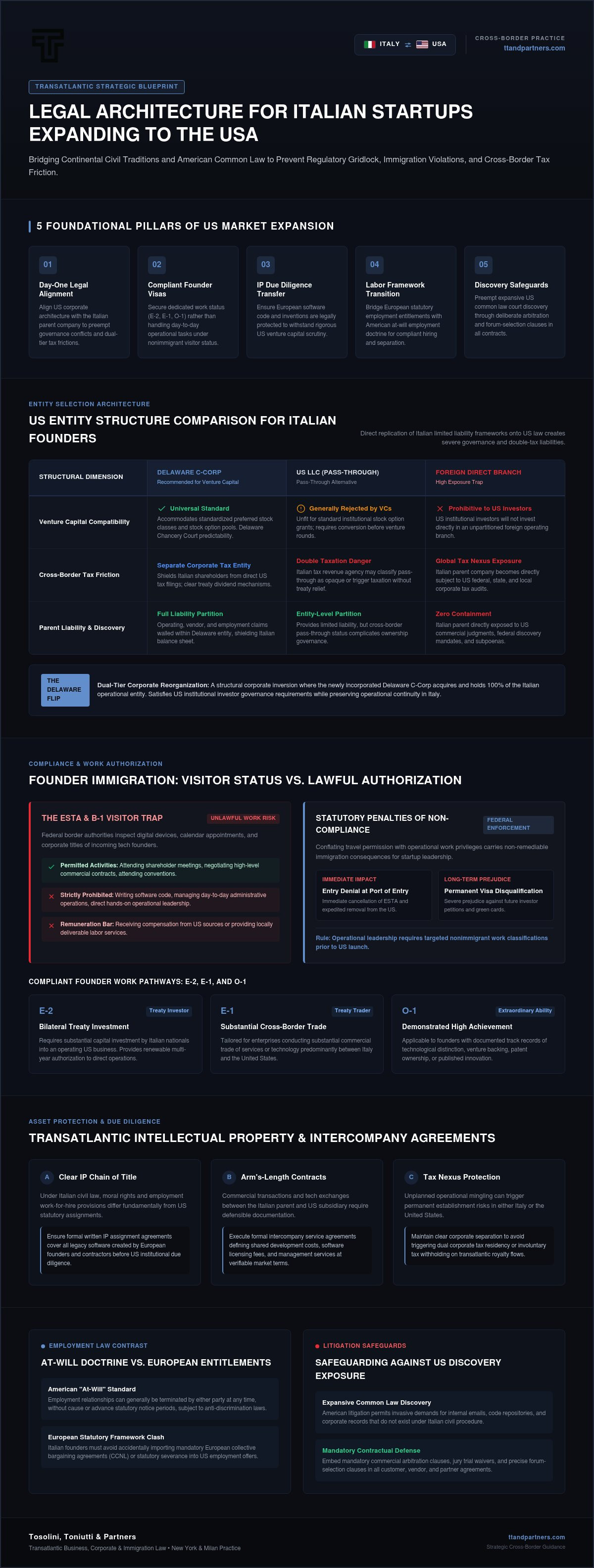
Founders expanding outward from Italy routinely attempt to replicate familiar domestic entities, mapping the standard Italian limited liability company directly onto an American framework. This structural shortcut represents one of the most perilous legal risks for Italian startups in the USA. American corporate law functions under distinct state-level statutes rather than a unified civil code, meaning entity selection dictates governance rules, tax exposure, and investor eligibility from inception.
Delaware C-Corp vs. LLC: Navigating the Transatlantic Dilemma
Venture capital institutions in the United States almost universally require a Delaware C-Corporation. This vehicle accommodates standardized preferred stock classes, stock option pools, and predictable corporate case law from the Delaware Court of Chancery. Conversely, while founders often consider an LLC incorporation for initial pass-through flexibility, this architecture frequently triggers unintended tax friction. Under cross-border tax principles, the Italian tax revenue agency may treat an American pass-through entity as an opaque corporation or subject individual Italian tax residents to double taxation without standard treaty relief.
Institutional funding typically demands a dual-tier framework or a corporate reorganization, flipping ownership so the Delaware entity holds the Italian operational company. This satisfies American venture expectations while maintaining localized European operations.
Cross-Border Subsidiary vs. Independent US Entity
Attempting to conduct commercial transactions directly through a foreign branch office creates unacceptable liability. A direct branch exposes the Italian parent company to American court jurisdictions, commercial claims, and broad discovery mandates. Establishing a dedicated corporate subsidiary provides an indispensable legal partition:
Liability containment: Operating claims, vendor obligations, and employment liabilities remain walled within the American entity, shielding the European parent balance sheet.
Contractual discipline: Clear intercompany service agreements govern shared development costs, software licensing, and administrative support at verifiable arm's-length terms.
Operational alignment: Managing a dedicated subsidiary allows leadership to transition commercial contracts toward the American at-will employment doctrine and local commercial practices without disturbing Italian corporate charters.
Addressing these fundamental corporate structures early eliminates catastrophic restructuring costs down the road, ensuring cross-border governance reinforces your commercial strategy rather than hindering investor diligence.
Founder Immigration Traps: Managing Visas and Lawful Work Authorization
Founders routinely risk operational momentum by conflating travel authorization with lawful work authorization. Stepping off a plane to close enterprise sales, manage engineers, or draw compensation while on nonimmigrant visitor status constitutes unlawful employment under federal statutes. Among the most destructive legal risks for Italian startups in the USA, an inadvertent immigration violation carries harsh consequences. A single finding of unauthorized work can lead to immediate entry denial, revocation of travel privileges, and permanent prejudice against subsequent corporate petitions or permanent residency.
The ESTA and B-1 Visa Trap During Early US Operations
The Electronic System for Travel Authorization (ESTA) and standard B-1 business visitor visas permit strictly circumscribed activities. Founders may attend shareholder meetings, negotiate commercial contracts, and participate in industry conferences. They cannot engage in hands-on operational leadership, code production, day-to-day administrative management, or receive US-sourced remuneration. Customs and Border Protection officers scrutinize incoming European tech founders closely, examining device communications, calendar bookings, and corporate affiliations to ensure commercial activities remain purely consultative.
Strategic Visa Pathways: Selecting Between E-2, E-1, and O-1
Executing an operational presence requires establishing a deliberate visa architecture aligned directly with your corporate structure. Italian founders benefit from specific bilateral treaties, provided their ownership and trade metrics satisfy statutory requirements:
E-2 Treaty Investor Visa: Governed by the historic bilateral Treaty of Friendship, Commerce and Navigation, the E-2 allows Italian citizens who own at least 50% of an enterprise to direct operations. Meeting official USCIS E-2 treaty investor requirements demands committing substantial, at-risk capital into active commercial operations rather than idle accounts. Review our comprehensive E-2 visa guide to plan this investment trajectory.
E-1 Treaty Trader Visa: Designed for companies demonstrating substantial, continuous trade between Italy and the United States, where more than 50% of the entity's total international volume flows bilaterally across the Atlantic.
O-1A Extraordinary Ability Visa: Founders possessing documented acclaim, institutional press coverage, significant venture backing, or transformative technical contributions can pursue the O-1 visa path without mandatory equity control or substantial capital deployments.
Coordinating visa petitions in tandem with corporate formation prevents expensive operational delays. If you need clarity on aligning founder status with your ongoing American operations, our cross-border counsel can help you evaluate compliant visa solutions that safeguard your business continuity.
Intellectual Property and Cross-Border Tax Exposure Under US Law
Securing venture capital in the United States requires an unassailable proprietary core. Yet, uncoordinated code creation and informal intellectual property management stand among the most damaging legal risks for Italian startups in the USA. When American investors commence technical due diligence, ambiguities surrounding software origin, founder ownership, and cross-border licensing can halt funding rounds instantly.
Securing Intellectual Property Assignments Across Jurisdictions
Continental civil law creates immediate friction with American intellectual property conventions. Under Italian law, moral rights remain deeply tied to individual authors and cannot simply be dissolved by contract. In contrast, American venture standards rely on the work-made-for-hire doctrine and exhaustive proprietary information agreements. If an Italian developer, contractor, or co-founder wrote foundational code before your American entity existed, your startup doesn't automatically own it cleanly under US legal doctrine.
To eliminate due-diligence defects, startups must execute formal bilateral intellectual property assignment agreements and confirmatory deeds across every individual contributor. Leadership must also clarify whether proprietary IP permanently resides in the Italian parent company or transfers directly to the American operating entity through formal assignment.
Avoiding Unintended Permanent Establishment and State Tax Nexus
Tax authorities on both sides of the Atlantic scrutinize transatlantic operations for irregular revenue attribution. Under the U.S.-Italy double taxation treaty provisions, an Italian business that routinely conducts commercial negotiations through dependent agents on American soil risks inadvertently establishing a taxable Permanent Establishment. This triggers immediate corporate tax reporting obligations with the Internal Revenue Service at the federal 21% rate, alongside state filing requirements.
Cross-border financial coordination requires meticulous adherence to several foundational protocols:
Transfer pricing compliance: Intercompany software licenses, technology fees, and management services between the Italian parent and US subsidiary must satisfy arm's-length pricing standards under Internal Revenue Code Section 482.
Withholding rate optimization: The bilateral treaty can reduce default cross-border dividend withholding taxes from 30% down to 5% for qualifying corporate entities owning at least 25% of voting stock for 12 months, preventing severe margin erosion.
Economic nexus monitoring: Individual US states enforce sales tax collection thresholds based entirely on gross transaction volume or revenue figures, irrespective of physical office presence.
Structuring clean IP assignments and clear intercompany transfer pricing agreements early safeguards your corporate balance sheet against sudden transatlantic audits.
Employment Law Clashes: At-Will Employment vs. European Entitlements
European founders accustomed to mandatory national collective bargaining agreements often view the American workplace landscape as frictionless. Under at-will doctrine, an employer can discharge an employee at any time, for any lawful reason or no reason at all. Yet, this flexibility masks severe workplace liability. Navigating these regulatory contrasts represents one of the subtlest legal risks for Italian startups in the USA. Without statutory severance formulas to limit disputes, contentious separations routinely morph into federal or state discrimination, retaliation, or wage claims.
The Independent Contractor Misclassification Landmine
Engaging American personnel through independent contractor arrangements to bypass state payroll registration is an exceptionally hazardous practice. Federal Department of Labor rules examine the economic realities of the relationship, focusing on behavioral direction, investment, opportunity for profit or loss, and operational integration. If you direct daily working hours, supply primary tools, or restrict working for competitors, regulatory agencies will classify that worker as a statutory employee.
Misclassification liability carries catastrophic cumulative penalties:
Back taxes and penalties: Unpaid federal and state payroll taxes, including social security and unemployment withholdings, along with statutory late payment interest.
Wage and hour damages: Unpaid overtime calculations under the Fair Labor Standards Act, accompanied by mandatory liquidated damages.
Benefit restitution: Retroactive liability for employee healthcare coverage, workers' compensation contributions, and accrued sick leave entitlements.
Structuring Stock Option Plans for Transatlantic Teams
Incentivizing early talent requires an American equity pool, but exporting Silicon Valley equity agreements directly into Europe creates immediate tax exposure. US equity plans must adhere strictly to Internal Revenue Code Section 409A, which requires independent formal valuations to set strike prices at fair market value. Setting strike prices below fair market value triggers a punitive 20% federal penalty tax on option holders upon vesting, plus accrued interest.
Issuing equity from a US Delaware parent to developers residing in Italy demands simultaneous compliance with the Italian consolidated income tax code. Without an adapted cross-border sub-plan, grants can trigger premature taxable events for European workers before any liquidity event occurs. Early-stage ventures must establish distinct global incentive rules so talent remains incentivized without distorting cross-border tax posture.
Building a resilient transatlantic team requires legal architecture that balances federal employment statutes with European worker expectations. To structure fully compliant employment agreements and avoid regulatory penalties, contact our cross-border legal team today.
Litigation Exposure and Dispute Resolution in the American Common Law System
Civil disputes in the United States operate under procedural rules that startle European founders accustomed to the codified judicial restraint of Italian courts. Under the American Rule, each party routinely pays its own legal fees regardless of who prevails, eliminating the automatic cost-shifting protection found in civil jurisdictions. Coupled with extensive pre-trial discovery, where opposing counsel can demand years of internal emails, code repositories, and Slack records, early-stage defense expenditures can rapidly surpass $150,000 before reaching summary judgment. These procedural realities amplify the operational legal risks for Italian startups in the USA, turning minor commercial disagreements into existential financial drains.
Drafting Enforceable Commercial Contracts and Liability Caps
Translating standard Italian commercial terms directly into American customer agreements creates massive vulnerabilities. Italian contracts often rely on statutory good-faith provisions to temper exposure. In American common law courts, judges enforce written text strictly as drafted. Defensible agreements must include precise risk partitions:
Consequential damages exclusions: Disclaim all indirect, punitive, special, and consequential losses to prevent speculative claims from reaching your balance sheet.
Contractual liability ceilings: Cap total recoverable damages at fees paid over a defined historical period, typically 6 to 12 months.
UCC warranty disclaimers: Expressly disclaim implied warranties of merchantability and fitness for a particular purpose using conspicuous, capitalized statutory language.
Startups must also ensure indemnification obligations remain tightly bounded to direct third-party intellectual property infringement claims, rejecting broad commitments to indemnify customers for generic regulatory non-compliance.
Governing Law, Forum Selection, and Mandatory Arbitration
Leaving choice-of-law and dispute venue unaddressed invites multi-state jurisdictional battles. If your contract lacks an exclusive forum selection clause, a disgruntled enterprise customer can haul your operating entity into an unfamiliar, plaintiff-friendly state court. founders should explore our analysis of international litigation to evaluate how cross-border disputes unfold in practice.
Mandatory binding arbitration provides the cleanest mechanism to manage commercial friction. Designating respected tribunals such as the American Arbitration Association (AAA) or the International Chamber of Commerce (ICC) keeps dispute proceedings entirely private, prevents run-away jury awards, and limits costly discovery battles. When combined with explicit jury trial waivers and class-action waivers, arbitration protects your growing enterprise from predatory common-law litigation.
Structuring sound dispute clauses requires nuanced transatlantic alignment from your initial contracts forward. You can consult with our cross-border litigation attorneys via our contact page to build enforceable commercial agreements that safeguard your enterprise.
Architecting Your Transatlantic Venture for Resilient Growth
Scaling into the American market rewards vision, but operational longevity demands structural discipline. Mitigating the critical legal risks for Italian startups in the USA isn't about slowing momentum; it's about engineering an enterprise capable of weathering venture due diligence, federal immigration audits, and common law liability. Aligning your corporate structure with Italian civil governance, securing lawful founder visas before launch, and insulating proprietary assets with precise contracts transform compliance into a decisive competitive advantage.
At Tosolini, Toniutti & Partners, we deliver bespoke US-Italy legal counsel spanning corporate formation, business immigration, and international litigation defense. Our bilingual attorneys bridge continental civil codes with the American legal system, offering seamless guidance from initial entity incorporation through founder visa approvals. When you build on an unassailable cross-border foundation, American expansion transitions from a regulatory hazard into an enduring market triumph. Schedule a confidential legal assessment to protect and accelerate your transatlantic expansion today.
Frequently Asked Questions
Can an Italian startup founder legally work in the US on an ESTA or B-1 visa?
No, an Italian founder cannot legally perform operational work or manage business activities under an ESTA or B-1 visa. These visitor classifications permit only limited, non-productive tasks like pitching prospective investors, attending trade conferences, or negotiating commercial terms. Actively managing staff, writing production code, or drawing American compensation violates federal immigration law. Overstepping these visitor boundaries creates severe legal risks for Italian startups in the USA, leading to revoked travel privileges or denied visas.
Is a Delaware C-Corporation always required when an Italian startup expands stateside?
A Delaware C-Corporation isn't mandatory for every venture, but it's the standard requirement for institutional venture capital investment. If your startup intends to bootstrap or enter commercial partnerships without external funding, an LLC or simple subsidiary might serve your operational goals. However, American institutional investors almost universally insist on Delaware corporate equity due to predictable case law and familiar share classes. Selecting the wrong entity architecture early complicates equity incentives and creates tax friction with Italian authorities.
What happens if an Italian startup accidentally triggers a Permanent Establishment in the US?
Accidentally triggering a Permanent Establishment forces the Italian startup to report and pay US federal corporate income tax on effectively connected income. The Internal Revenue Service applies the 21% flat corporate tax rate to those earnings, accompanied by mandatory state corporate tax obligations. Additionally, the startup faces stringent transfer pricing audits, potential back taxes, and statutory interest penalties. Maintaining clear intercompany service agreements ensures operational sales activities don't inadvertently create this corporate exposure.
Can European employee stock options be granted to US workers without special tax filings?
No, you cannot grant European equity incentives to American workers without adhering to US tax standards. Under Internal Revenue Code Section 409A, stock options granted to US service providers must reflect a formal, independent fair market valuation. If options are granted with an exercise price below fair market value, the employee incurs immediate income taxation on vesting, plus a 20% federal penalty tax. Structuring a compliant transatlantic equity plan prevents these adverse tax liabilities.
How does the US-Italy Bilateral Tax Treaty prevent double taxation for emerging startups?
The bilateral treaty establishes clear mechanisms to credit income taxes paid in one jurisdiction against liabilities owed in the other. It defines precise corporate residency rules, prevents dual taxation of operating profits, and lowers statutory withholding taxes on transatlantic payments. For instance, dividend withholding drops from the default 30% rate to 5% for qualifying corporate entities owning at least 25% of voting stock. Addressing these provisions minimizes the fiscal legal risks for Italian startups in the USA.
What is the difference between an E-2 treaty investor visa and an O-1 visa for startup founders?
The primary difference lies in capital commitment versus demonstrated individual acclaim. An E-2 treaty investor visa requires an Italian national to own at least 50% of an enterprise and commit substantial at-risk capital into active operations. In contrast, the O-1A visa requires no personal capital investment or minimum equity ownership; instead, it demands documented evidence of extraordinary ability, such as venture backing, technical awards, or press recognition within the international startup ecosystem.
Can an Italian parent company be sued directly in American courts for actions taken by its US subsidiary?
An Italian parent company generally cannot be sued for subsidiary conduct if both entities maintain strict corporate separateness. However, American plaintiffs frequently attempt to pierce the corporate veil if the two companies commingle bank accounts, share directors without formal intercompany contracts, or operate without proper board resolutions. Preserving separate corporate records, clear intercompany service agreements, and distinct operational governance shields the European parent entity from being dragged into American common law litigation.


Comments