

US Visa Options for Italian Professionals: 2026 Guide
- Gianni Mendes Toniutti, Esq.

- 5 days ago
- 12 min read
Updated: 2 days ago
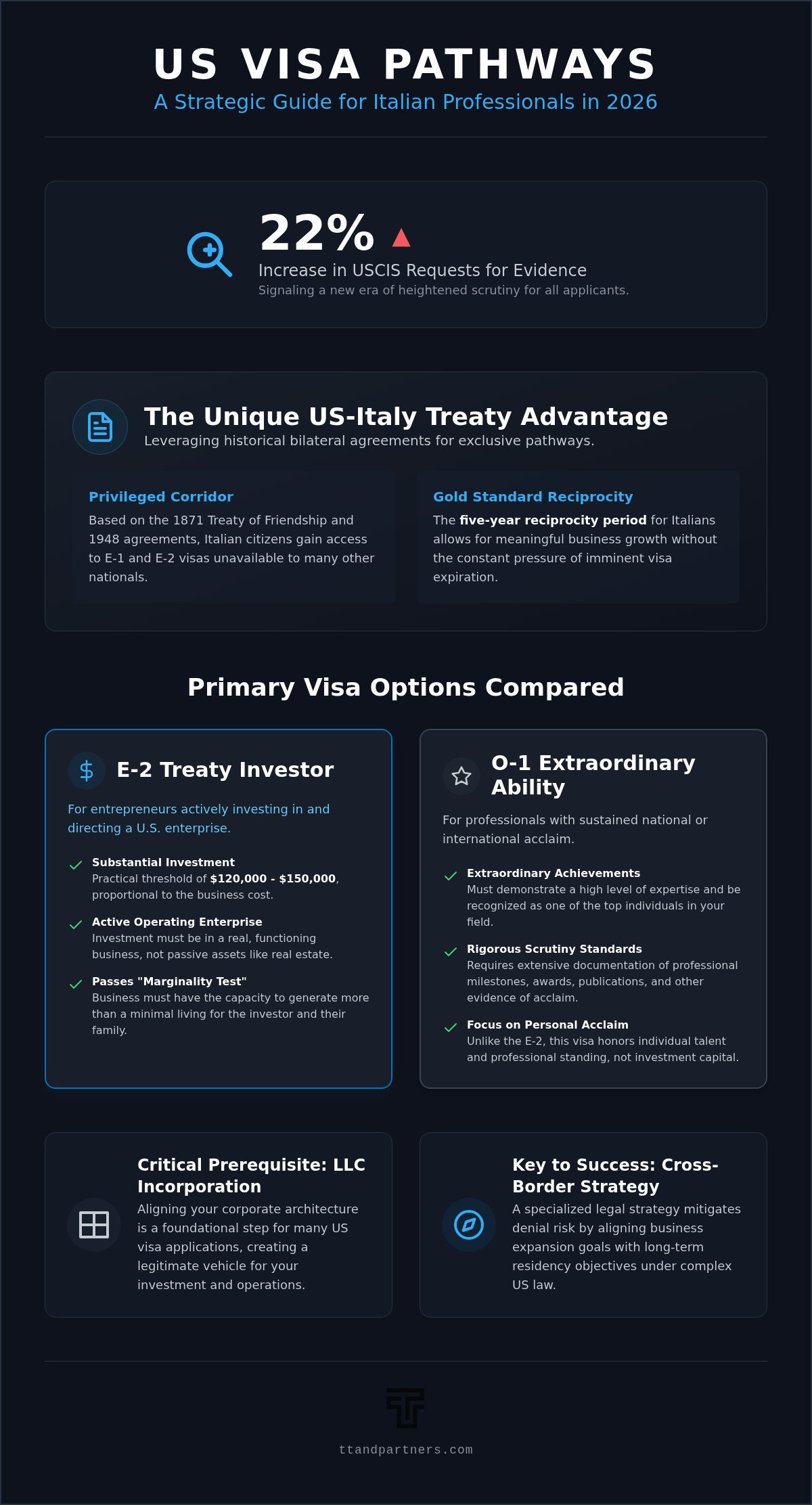
Did you know that USCIS issued 22% more Requests for Evidence last year, signaling a new era of heightened scrutiny for those pursuing US visa options for Italian professionals? For Italian entrepreneurs and visionaries, the American market represents the ultimate frontier for growth, yet the path is often obscured by a dense thicket of regulatory nuances and the specific complexities of US-Italy bilateral treaties. We understand that the fear of a visa denial isn't just about paperwork; it's about the potential disruption of your business timelines and the delay of a long-held vision.
You deserve a strategy that matches the sophistication of your professional credentials. This guide explores the most effective pathways, offering a clear roadmap to residency and successful business expansion in 2026. We'll examine the updated investment thresholds for E-2 Treaty Investors, the rigorous standards for O-1 extraordinary ability petitions, and the strategic alignment of your professional background with these specific legal categories. By the end, you'll have the intellectual framework needed to transform complex immigration laws into a structured plan for your American future.
Table of Contents
Understanding the Unique US-Italy Treaty Advantage for Professionals
The E-2 Treaty Investor Visa: A Preferred Route for Italian Entrepreneurs
The O-1 Visa: Securing Status Through Extraordinary Professional Achievement
Bridging the Gap: LLC Incorporation and Professional Readiness
Strategic Legal Counsel: Navigating US Immigration with TT&P
Understanding the Unique US-Italy Treaty Advantage for Professionals
The foundation of US visa options for Italian professionals lies in a sophisticated legal heritage that predates modern immigration frameworks. While many European professionals face the constraints of general immigration quotas, Italian citizens benefit from the 1871 Treaty of Friendship, Commerce, and Navigation, later reinforced by the 1948 bilateral agreements. This legal framework creates a privileged corridor for trade and investment, positioning Italian entrepreneurs and experts in a category of their own. It's a relationship built on reciprocity; the United States grants specific privileges to Italians because Italy extends similar opportunities to American interests. This symmetry isn't just a historical footnote. It's a living legal reality that dictates the duration of your stay and the ease with which you can renew your status.
The Significance of Treaty Status
The most prominent manifestations of this treaty are the E-1 Treaty Trader and E-2 Treaty Investor Visa categories. These pathways are strictly treaty-dependent, meaning they're only available to nationals of countries with which the US maintains these specific agreements. For an Italian professional, this status is a powerful asset. It allows for a level of flexibility in business operations and residency that other non-immigrant visas cannot match. In 2026, as regulatory scrutiny intensifies, the clarity provided by these treaty-based definitions offers a more stable ground for long-term strategic planning. The five-year reciprocity period for Italians remains a gold standard, allowing for meaningful business growth without the constant pressure of imminent expiration. It's a strategic advantage that transforms the immigration process from a hurdle into a structured business move.
Italian Professional Credentials in the US
The E-2 Treaty Investor Visa: A Preferred Route for Italian Entrepreneurs
The E-2 Visa remains the most dynamic of the US visa options for Italian professionals because it prioritizes entrepreneurial action over rigid academic quotas. In 2026, the definition of a substantial investment has evolved into a nuanced proportionality test. While there's no statutory minimum, the practical threshold for a credible application typically ranges between $120,000 and $150,000. It's not just about the dollar amount; it's about whether the capital is sufficient to ensure the business's successful operation. Unlike the O-1 Visa for Individuals with Extraordinary Ability, which honors personal acclaim, the E-2 honors your commitment to the US economy.
The enterprise must be a real, operating entity. Passive investments, such as holding residential real estate or uncommitted bank balances, won't suffice. USCIS and consular officers apply a marginality test to ensure the business possesses the present or future capacity to generate more than a minimal living for the investor and their family. To qualify, the US entity must be at least 50% owned by Italian nationals, maintaining a clear link to the treaty country. Proving this requires a meticulous audit of the corporate structure and the source of funds to ensure every euro is documented and at risk.
Investment Strategies for Italian Professionals
Capital allocation requires a bespoke approach. A consulting firm in Manhattan has different capital requirements than a manufacturing facility in the Midwest. Using an E-2 visa investment strategy that aligns with industry benchmarks is essential for passing the proportionality test. Funds must be irrevocably committed to the business. This means the capital is at risk in the commercial sense, demonstrating a genuine intent to succeed. If you're unsure how your specific capital structure fits these requirements, consulting with a cross-border specialist can provide the necessary clarity before you commit significant assets.
The 5-Step E-2 Application Framework
A successful petition follows a logical, architectural progression that addresses both legal and commercial realities. It's a process that demands precision at every stage to avoid the 15% denial rate often seen in poorly documented cases.
Step 1: Entity Formation. Establish a US legal entity, typically an LLC, ensuring the ownership structure reflects Italian nationality.
Step 2: Capital Commitment. Execute the investment. Purchase equipment, sign leases, or acquire inventory to prove the business is ready to launch.
Step 3: Strategic Planning. Develop a five-year business plan. This document must project growth and job creation to satisfy the marginality requirement.
Step 4: Submission. Choose between consular processing in Italy for a five-year visa or a change of status within the US.
Step 5: The Interview. Prepare to articulate your business vision and operational role with precision.
The O-1 Visa: Securing Status Through Extraordinary Professional Achievement
While investment-based pathways rely on liquid capital, the O-1 visa honors the intellectual and creative capital inherent in the Italian professional class. It's often the preferred route for scientists, artists, and tech visionaries who've reached the pinnacle of their fields in Italy and now seek to scale their influence in the US market. Unlike the E-2, which requires a substantial financial commitment, the O-1 focuses on your "distinguished" track record. For many, the O-1 visa for entrepreneurs provides a strategic alternative when talent and past success outweigh the desire for immediate capital expenditure. In 2026, USCIS has intensified its focus on the quality of evidence, making the strategic presentation of your Italian accolades more critical than ever.
The O-1 category is particularly effective for Italians because of the nation's deep-rooted culture of excellence in specialized sectors. Whether it's a researcher from a top Milanese institute or a designer with international awards, the key is demonstrating that you're among the small percentage at the top of your profession. Peer recommendations from industry leaders in both Rome and New York serve as essential pillars for these petitions. These letters shouldn't just praise your work; they must provide technical analysis of your specific contributions to the field. With a 22% increase in Requests for Evidence (RFEs) reported in late 2025, your narrative must be airtight from the initial filing.
Criteria for Extraordinary Ability in 2026
Meeting the O-1 standard requires satisfying at least three of the eight regulatory criteria. For Italian applicants, this often involves documenting memberships in prestigious professional associations or highlighting a high salary that significantly exceeds the Italian industry average. Published material in major professional journals or trade publications, such as Il Sole 24 Ore or specific academic periodicals, carries substantial weight. If you don't have a single US employer, you can utilize a US agent to sponsor your petition. This agent-based model is ideal for consultants or creatives who plan to work on multiple projects across the United States. If you need a fast decision, the premium processing fee of $2,965 guarantees a USCIS response within 15 business days.
Strategic Evidence Collection
Collecting evidence is an exercise in translation, not just of language, but of prestige. You must demonstrate that your Italian awards and honors are recognized as significant within your global industry. For the 2026 fiscal year, the "extraordinary ability" standard is defined as a level of expertise indicating that the person is one of the small percentage who has risen to the very top of the field of endeavor. Expert opinion letters from US and Italian industry leaders provide the necessary context to bridge this gap. These documents transform a list of achievements into a visionary professional narrative. If you're weighing these US visa options for Italian professionals, contacting a specialist can help you determine which of your accolades will resonate most with US adjudicators.
Bridging the Gap: LLC Incorporation and Professional Readiness
Securing your legal status is a significant milestone, but the structural integrity of your American enterprise determines its long-term viability. For those exploring US visa options for Italian professionals, the synergy between LLC incorporation and immigration eligibility is absolute. A US legal entity isn't merely a container for operations; it's the foundation that USCIS examines to verify the legitimacy of your professional presence. For E-1 and E-2 applicants, the corporate structure must be established before the petition is even filed. This ensures that the investment is "at risk" and the trade is "active" according to 2026 regulatory standards. Beyond the visa, Italian professionals must remain vigilant regarding the tax implications of operating a US business. Missteps in corporate compliance don't just lead to financial penalties; they can jeopardize your ability to renew your visa in the future.
Selecting the Right US Business Structure
The choice between an LLC and a C-Corp often hinges on your specific professional goals and the nature of your investment. Most Italian entrepreneurs prefer the LLC for its flexibility and pass-through taxation, which can be advantageous when navigating the US-Italy tax treaty. However, if you're seeking venture capital or plan to go public, a C-Corp might be more effective. Regardless of the structure, obtaining an Employer Identification Number (EIN) and opening a US business bank account are non-negotiable steps. These elements provide the documented trail of financial activity that consular officers require. Strategic asset protection is equally vital for the cross-border professional, ensuring that your personal Italian assets remain insulated from US business liabilities.
E-1 Treaty Trader Opportunities
While much attention is given to investment, the E-1 visa offers a distinct path for those whose primary activity is the exchange of goods or services. To qualify, at least 50% of the international trade must be between the United States and Italy. This "substantial trade" is defined by the volume and frequency of transactions rather than a single large shipment. It's an ideal category for Italian export companies or specialized service providers who've already established a foothold in the American market. As your US business scales, it's common to transition from a trade-based E-1 to an investment-based E-2 model. If you're ready to begin this transition, establishing your US business architecture with professional guidance is the most secure way to protect your professional future.
Strategic Legal Counsel: Navigating US Immigration with TT&P
The transition from an Italian professional environment to the American market isn't merely a geographic shift; it's a structural transformation. Successfully identifying the right US visa options for Italian professionals requires more than a checklist. It demands a deep understanding of how Italian corporate law interacts with US immigration statutes. At Tosolini, Toniutti & Partners, we act as the essential bridge for those who value precision and long-term vision. Our expertise isn't confined to filling forms. We manage the intersection of international litigation, corporate formation, and immigration to ensure your business architecture supports your residency goals.
Many of our clients begin with non-immigrant pathways like the E-2 or O-1, but the ultimate objective often shifts toward permanent residency. Moving from a temporary status to a Green Card requires a forward-looking strategy established at the moment of your first filing. We design a personalized legal architecture that anticipates these shifts, ensuring your professional credentials and business growth align with future immigrant visa categories. It's about creating a trajectory that remains stable even as regulatory environments evolve.
The TT&P Advantage for Italians
Our firm's strength lies in our dual-market awareness. We don't just understand the US requirements; we understand the Italian background they're compared against. This includes nuanced knowledge of the Italian Laurea, professional certifications, and the specific operational styles of Italian firms. We provide a holistic approach where your US expansion is supported by:
Expert Credential Translation. Aligning your Italian professional history with US regulatory standards.
Corporate Synergy. Ensuring your LLC or C-Corp structure satisfies both tax efficiency and visa requirements.
Integrated Services. Coordinating immigration with real estate closings and international business litigation.
Take the Next Step in Your US Expansion
The complexity of 2026 immigration standards means that early assessment is your most valuable asset. A preliminary eligibility review helps identify potential hurdles before they impact your business timelines. When you're ready to define your American future, you can contact Tosolini, Toniutti & Partners to schedule a strategic consultation. This first session is an opportunity to translate your professional vision into a structured, legally sound expansion plan. We believe in an collaboration-based approach, working as strategic thinkers who help you navigate the delicate balance between Italian heritage and American opportunity.
Architecting Your Professional Future in the United States
The path to American expansion for Italian visionaries is built on a foundation of historical treaty privileges and modern legal precision. We've explored how the E-2 and O-1 categories offer distinct advantages, provided they're supported by a robust corporate structure. Success in 2026 isn't just about meeting the minimum criteria. It's about the strategic alignment of your professional legacy with your future residency goals.
Navigating the diverse US visa options for Italian professionals requires a partner who understands both the Milanese boardroom and the American regulatory landscape. With decades of specialized experience in US-Italy immigration, Tosolini, Toniutti & Partners provides comprehensive support from initial LLC incorporation to long-term Green Card strategy. We don't just process applications; we architect the legal framework for your success. Every detail of your business structure and professional history is leveraged to ensure your transition is seamless and secure.
Your professional journey deserves a strategy as sophisticated as your credentials. Consult with our US-Italy cross-border legal experts today to begin defining your American chapter with confidence. The frontier of your business growth is waiting.
Frequently Asked Questions
What are the most common US visa options for Italian professionals in 2026?
The most effective US visa options for Italian professionals in 2026 include the E-2 Treaty Investor, E-1 Treaty Trader, and O-1 Extraordinary Ability visas. These categories leverage the unique bilateral treaties between Italy and the United States. While E-visas focus on commercial activity and investment, the O-1 recognizes individual professional excellence. Each path provides a structured route for Italian citizens to establish a high-level presence in the American market.
How much investment is required for an Italian citizen to get an E-2 visa?
There's no fixed dollar amount for an E-2 investment, but the capital must be substantial relative to the business's total cost. In 2026, a practical minimum for a service-based enterprise is generally considered to be between $120,000 and $150,000. For lower-cost startups, the investment should cover 75% to 100% of the total setup costs to satisfy the proportionality test used by US consular officers.
Can an Italian professional apply for an O-1 visa without a US employer?
You can apply for an O-1 visa without a traditional US employer by utilizing a US-based agent as your petitioner. This structure is particularly beneficial for Italian consultants, artists, or entrepreneurs who intend to work on multiple projects or for various clients. The agent acts as the legal sponsor, coordinating your professional itinerary and ensuring that your specialized services meet the extraordinary ability standards required by USCIS.
How long does it take for an Italian national to obtain a US professional visa?
The timeline for obtaining a professional visa depends on the filing method and the specific category chosen. Consular processing in Italy typically takes three to six months, while applications filed within the US can be expedited via premium processing. For an additional fee of $2,965, USCIS guarantees a decision within 15 business days for O-1 and certain E-visa change-of-status petitions, providing a faster route for time-sensitive business expansions.
What is the difference between an E-1 and E-2 visa for Italian companies?
The primary difference lies in the nature of the commercial activity: E-1 visas focus on trade, while E-2 visas focus on investment. An E-1 Treaty Trader must demonstrate substantial, ongoing international trade where at least 50% of the volume is between Italy and the US. Conversely, the E-2 Treaty Investor requires the irrevocable commitment of capital into a real, operating US enterprise with the capacity to generate significant economic impact.
Does an Italian professional need a US company to apply for an E-2 visa?
Yes, establishing a US legal entity, such as an LLC or Corporation, is a mandatory prerequisite for the E-2 visa. This entity serves as the vehicle for your investment and must be at least 50% owned by Italian nationals to maintain treaty eligibility. Incorporating before you file ensures that your capital is at risk and that the business is legally prepared to begin operations upon your arrival.
Can I transition from an E-2 visa to a Green Card as an Italian citizen?
Transitioning from an E-2 visa to a Green Card is possible, though the E-2 itself is a non-immigrant category that doesn't lead directly to residency. Many people exploring US visa options for Italian professionals use their temporary status as a strategic bridge while they pursue immigrant petitions like the EB-1 or EB-2 categories. This transition requires careful planning to ensure your professional activities align with the more rigorous standards of permanent residency.
Is the US-Italy tax treaty helpful for professional visa holders?
The US-Italy tax treaty is a vital tool for professional visa holders, as it prevents double taxation on income earned in both jurisdictions. It provides specific rules for determining tax residency and offers reduced withholding rates on dividends, interest, and royalties. Understanding these provisions allows Italian entrepreneurs to optimize their global tax position while maintaining full compliance with both the IRS and the Italian Agenzia delle Entrate.


Comments