

What to Do If Your O-1 Visa Is Denied: A Strategic Recovery Guide for 2026
- Gianni Mendes Toniutti, Esq.

- Jun 28
- 12 min read
Updated: Jul 21
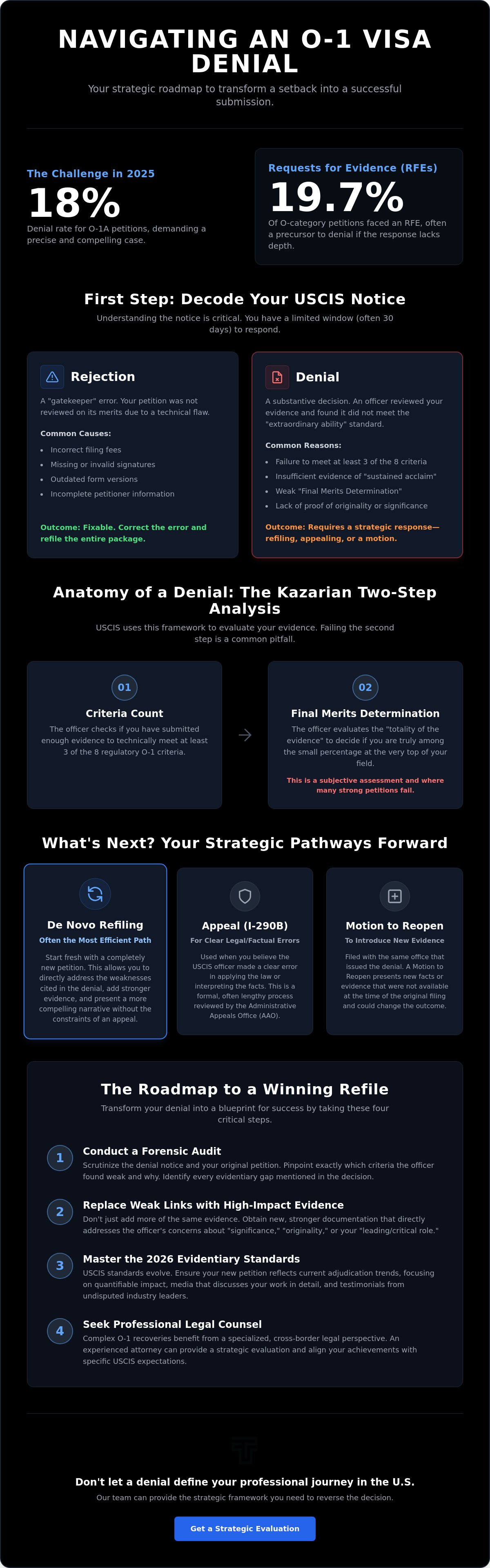
With an 18% denial rate for O-1A petitions recorded in 2025, even the most visionary careers can be momentarily eclipsed by a rigid administrative decision. Receiving a denial notice doesn't just represent a loss of filing fees. It feels like a disruption of the professional harmony you've worked so hard to establish. You've likely spent months curating evidence of your global impact, only to find that USCIS standards demand an even more precise level of intellectual and technical documentation.
If you're wondering what to do if O-1 visa is denied, it's essential to view this moment as a structural flaw to be corrected rather than a final verdict. This guide provides the strategic framework you need to reverse the decision and secure your status in the United States. We'll explore the tactical differences between a motion to reopen and a complete refiling, analyze the 2026 evidentiary trends, and show you how to transform a denial into a roadmap for a successful, high-impact submission.
Table of Contents
Decoding the USCIS Denial Notice: Rejection vs. Denial
The arrival of a USCIS envelope represents a critical junction in your professional journey. It's easy to feel a sense of finality when you see a negative result, but understanding the specific nature of that notice is the first step toward recovery. You must act with clinical precision. Most notices allow a 30-calendar day window for a response or appeal; a timeline that leaves no room for hesitation. If you're wondering what to do if O-1 visa is denied, the priority is to identify whether you've received a rejection or a substantive denial.
A rejection is essentially a gatekeeper error. It means your petition was never actually reviewed on its merits because of a technical flaw. In contrast, a denial is a formal judgment. An adjudicating officer has reviewed your evidence and concluded that you haven't met the high standards required for the O-1 visa category. Sometimes, USCIS issues a "Notice of Intent to Deny" (NOID) before a final decision. This is a warning shot. It outlines exactly why the officer is skeptical, providing a final opportunity to bridge the gap with superior evidence before the case is officially closed.
Common Administrative Errors Leading to Rejection
Technicalities often trip up the most brilliant minds. In 2026, USCIS remains rigorous about form versions and exact fee amounts. A missing signature or an incomplete petitioner section triggers an immediate return of the package. These errors are frustrating but fixable. They don't reflect on your "extraordinary ability" but rather on the administrative architecture of the filing. Establishing a clear agency agreement or a valid employer-employee relationship is also a frequent stumbling block, especially for independent professionals who utilize agents to manage multiple US engagements.
Substantive Denials and the Burden of Proof
Substantive denials are more complex because they challenge your professional standing. Officers apply the "Preponderance of Evidence" standard, meaning you must prove it's more likely than not that you qualify. However, meeting three out of eight criteria is only the first hurdle. The "Final Merits Determination" allows officers to look at the evidence as a whole. They judge whether your work truly resonates at the top of your field. When analyzing what to do if O-1 visa is denied on substantive grounds, you must look at the officer's written reasoning. They often cite gaps in the "significance" of your awards or the "originality" of your contributions. If you need a forensic review of your denial notice to plan your next steps, you can reach out to our team at TT&Partners for a strategic evaluation.
Evaluating the Core Reasons for O-1 Denial in 2026
A denial notice often reveals a fundamental misalignment between a candidate's professional reality and the evidentiary standards of USCIS. In 2025, approximately 19.7% of O-category petitions faced a Request for Evidence, and many of these eventually resulted in a denial because the response lacked intellectual depth. When assessing what to do if O-1 visa is denied, you must first determine if the failure was a quantitative lack of evidence or a qualitative failure in presentation. Adjudicators in 2026 are looking beyond mere participation in a field; they seek evidence of a transformative impact that sets the individual apart from their peers.
The most common technical failure is the inability to satisfy at least three of the official USCIS O-1 criteria. However, even when three categories are technically met, petitions often fail due to a lack of sustained national or international acclaim. This requirement demands proof that your recognition isn't a fleeting moment of success but a consistent, high-level trajectory of achievement that continues into the present day. If you're struggling to bridge this gap, a strategic evaluation of your portfolio can provide the necessary clarity.
The Kazarian Standard and Final Merits Determination
USCIS employs a two-step evaluation process known as the Kazarian standard. First, the officer checks if you've provided enough documents to count toward three criteria. Second, they perform a Final Merits Determination. This is where many qualified applicants falter. The officer evaluates the total evidence to decide if you're truly among the small percentage at the top of your field. It's no longer enough to simply show you've played a leading or critical role in an organization. You must prove the organization itself has a distinguished reputation and that your specific contributions changed the entity's outcome. Understanding what to do if O-1 visa is denied requires a forensic look at how these weighing factors were applied to your specific case.
Issues with Expert Opinion Letters and Peer Evidence
Strategic Options: Refiling, Appealing, or Moving to Reopen
Deciding what to do if O-1 visa is denied requires a clinical assessment of your timeline and the specific weaknesses identified in the denial notice. You aren't merely responding to a rejection; you're choosing a path that balances legal rigor with professional necessity. The three primary routes include filing a motion via Form I-290B, submitting a formal appeal to the Administrative Appeals Office (AAO), or pursuing a de novo refiling. Each path carries distinct implications for your ability to remain in the United States and the speed at which you can resume your professional engagements.
The De Novo Filing (Refiling) Advantage
Starting fresh is often the most pragmatic strategy for high-level professionals. A de novo filing allows you to submit an entirely new petition that addresses the previous officer's concerns without being tethered to the original, flawed record. You can curate more potent evidence, source stronger expert letters, and refine your narrative. By utilizing Premium Processing, you can secure a decision in just 15 days. This speed is invaluable for professionals facing career interruptions. In your new cover letter, you should transparently address the previous denial while demonstrating how the current submission provides the specific clarity the first one lacked.
When an AAO Appeal is the Right Move
An appeal to the AAO is reserved for cases where USCIS has made a clear legal or factual error. It isn't a second chance to submit better evidence. It's a challenge to the officer's interpretation of the law. However, this route requires significant patience. The AAO typically takes 6 to 12 months to issue a decision. Crucially, if you are an O-1B applicant in the arts or television, you cannot appeal to the AAO. Your only recourse within the I-290B framework is a motion to reopen or reconsider. For most applicants, the lengthy wait time makes an appeal less attractive than a strategic refiling.
Filing Form I-290B involves a $675 fee and must be completed within 30 calendar days of the decision. A motion to reopen is appropriate if you have new facts to present that weren't available during the initial filing. A motion to reconsider argues that the decision was based on an incorrect application of law or policy. Given the complexities of the current 2026 immigration climate, choosing the wrong path can lead to further delays. If you're uncertain which strategy fits your specific denial, you can discuss your options with our team at TT&Partners to ensure your next move is architected for success.
Building a Stronger O-1 Petition for Your Second Attempt
A successful recovery begins with a forensic audit. You must dissect the denial notice with the same rigor an architect applies to a structural failure. It isn't enough to simply know the case failed; you must understand why the officer remained unconvinced during the Final Merits Determination. Often, the issue isn't a lack of talent but a failure to translate that talent into the specific technical language USCIS requires. This audit must identify whether the 'weak link' was a lack of objective evidence or a failure in the narrative arc of the petition. If you are strategizing what to do if O-1 visa is denied, your second submission must feel like a completely new, more sophisticated iteration of your professional narrative.
Enhancing Documentary Evidence and Press Coverage
Quality outweighs quantity in the 2026 adjudicatory environment. Officers are increasingly skeptical of local press or pay-to-play media placements. Your strategy should shift toward major trade publications or global media outlets that carry inherent prestige. Don't just claim an organization is "distinguished"; prove it with objective metrics:
Verified annual revenue or market capitalization of the entity.
Third-party rankings or industry-specific awards won by the organization.
Historical impact of the entity's work on the global market or local city structure.
If you're citing a lead role, provide evidence that your specific involvement led to a measurable increase in the entity's success. This quantitative approach leaves less room for subjective doubt during the weighing of evidence.
The Architecture of the Legal Brief
The cover letter is the intellectual foundation of your petition. It shouldn't merely list your exhibits. It must connect the dots for the adjudicator, explaining how each piece of evidence satisfies the O-1 visa criteria with surgical precision. A well-structured brief anticipates the officer's questions and answers them before they can form a doubt. Your index of exhibits should be organized for maximum clarity, allowing the officer to flow through your achievements without friction.
Sometimes, the flaw lies with the petitioner itself. If your initial filing utilized an agent or sponsor with a weak US presence, refiling with a more established entity can drastically change the case's outcome. Officers look for a synergy between the sponsor's reputation and the applicant's talent. Reframing your "Field of Endeavor" can also provide a fresh perspective. A narrower, more specialized field often makes it easier to prove you are at the very top of that specific niche. Deciding what to do if O-1 visa is denied involves these high-level pivots that turn a previous failure into a future approval. If you're ready to rebuild your case with this level of strategic depth, contact our legal team for a forensic review of your denial.
Professional Legal Counsel for Complex O-1 Recoveries
A visa denial often acts as a catalyst for a more profound professional recalibration. It isn't merely a bureaucratic setback; it's a signal that the narrative of your extraordinary ability requires a more sophisticated architectural foundation. When you're determining what to do if O-1 visa is denied, the solution rarely lies in repeating the same arguments with more volume. It requires a specialized cross-border legal perspective that can bridge the intellectual gap between your international achievements and the rigid evidentiary standards of USCIS. This level of complexity demands more than just a filing service. It requires a strategic partner who understands the nuances of global career trajectories.
The TT&Partners approach is rooted in a unique duality: we combine a visionary outlook on global mobility with the engineering precision required for high-stakes immigration litigation. We treat every recovery as a design challenge, where the goal is to rebuild your petition to be structurally sound and aesthetically persuasive. For entrepreneurs and innovators, this might involve re-evaluating your corporate structure. In some cases, a strategic LLC incorporation can provide the necessary petitioner framework that was missing from your initial attempt, creating a more professional and credible tie to the US market.
The Value of a Strategic Consultation
A denial is an opportunity to zoom out and look at the broader horizon of your US journey. During a forensic review of your case, we identify if your profile is better aligned with an O-1 for entrepreneurs or if a different classification, such as an E-visa, offers a more harmonious path to your goals. We don't just solve for the current denial. We architect a roadmap that leads toward a Green Card, ensuring that your second O-1 attempt serves as a stable stepping stone for permanent residency. This holistic perspective ensures that your career remains mended and forward-moving, rather than stalled by a single administrative decision.
Your next step shouldn't be a hurried refiling. It should be a deliberate, intellectual audit of the USCIS reasoning. By analyzing the specific friction points in your previous notice, we can develop a submission that leaves no room for doubt or misinterpretation. If you're ready to transform your denial into a strategic victory, you can contact Tosolini, Toniutti & Partners for an immediate and precise case evaluation. We believe that extraordinary talent deserves an extraordinary defense, and we're committed to helping you secure the status your work has already earned.
Architecting Your Professional Future in the United States
The path to extraordinary ability status is rarely linear. It requires the same persistence and precision that defined your career achievements. You now understand that a denial notice is actually a structural blueprint for your next submission. By distinguishing between technical rejections and substantive denials, you can decide whether a rapid de novo refiling or a targeted motion is the most efficient route forward. Success in 2026 hinges on a forensic audit of your portfolio and the replacement of generic endorsements with high-impact, objective metrics.
Knowing what to do if O-1 visa is denied transforms a moment of frustration into a strategic pivot. At Tosolini, Toniutti & Partners, we bring decades of experience in US-Italy cross-border immigration and specialized expertise in O-1 recoveries for high-net-worth individuals. Our team provides the strategic litigation support necessary to navigate complex disputes and restore your professional harmony. Don't let an administrative hurdle define your global trajectory.
Schedule a Strategic Consultation with Our O-1 Experts to begin architecting your recovery. Your vision for a career in the United States remains within reach and entirely achievable.
Frequently Asked Questions
Can I stay in the US after my O-1 visa is denied?
Your ability to remain in the US depends entirely on whether you possess another valid non-immigrant status. If your O-1 petition was an extension and it's denied after your previous I-94 has expired, you don't have a legal basis to stay and must depart immediately. Accruing unlawful presence can have severe consequences for your future eligibility, so it's vital to verify your status the moment you receive the notice.
How many times can I refile for an O-1 visa after a denial?
There is no statutory limit on the number of times you can refile a petition. USCIS treats each new filing as a separate case, provided you pay the required fees and submit the necessary forms. When considering what to do if O-1 visa is denied, the focus shouldn't be on the number of attempts but on the quality of the new evidence. Each subsequent filing must be a more sophisticated, architecturally sound version of your professional narrative.
Does an O-1 denial affect my future chances for a Green Card?
An O-1 denial isn't a permanent bar to permanent residency. Because the O-1 is a non-immigrant visa, a denial based on evidentiary merits won't automatically disqualify you from an EB-1A or EB-2 NIW Green Card petition. However, the same weaknesses identified by the officer in your O-1 case will likely be scrutinized in an immigrant petition. You must resolve those documentary gaps before moving toward a more permanent status.
What is the difference between an RFE, a NOID, and a Denial?
These terms represent escalating levels of USCIS scrutiny. A Request for Evidence (RFE) is a neutral request for more information to help the officer make a decision. A Notice of Intent to Deny (NOID) is a more serious warning, stating the officer intends to deny the case unless you provide a persuasive rebuttal. A denial is the final decision on the merits, indicating that the burden of proof wasn't met.
How much does it cost to appeal an O-1 visa denial in 2026?
The filing fee for Form I-290B, Notice of Appeal or Motion, is $675 in 2026. This fee is required regardless of whether you are filing a motion to reopen, a motion to reconsider, or a formal appeal to the Administrative Appeals Office. This cost is separate from any legal fees or the costs associated with gathering new, high-impact evidentiary documentation for your response.
Can I change my sponsor or agent when refiling my O-1 petition?
Changing your sponsor or agent is often a strategic necessity during a refiling. If the denial notice cited issues with the petitioner's ability to provide work or the validity of the agency agreement, switching to a more established entity can fix the case's structural flaws. A new sponsor with a distinguished reputation can also add significant weight to the "Final Merits Determination" of your petition.
How long do I have to leave the US if my O-1 extension is denied?
You must generally leave the US immediately if your extension is denied and your previous status has already expired. USCIS doesn't provide an automatic grace period following a denial decision. If you remain in the country after the date on the notice, you begin accruing unlawful presence, which could lead to a three-year or ten-year bar on re-entry depending on the length of the overstay.
Is it better to file a Motion to Reopen or a new O-1 petition?
Filing a new O-1 petition is usually the most efficient way to address what to do if O-1 visa is denied. While a motion is restricted to the existing record and specific new facts, a new petition allows you to utilize Premium Processing for a 15-day decision. This de novo strategy is often faster and more flexible than waiting months for a motion to be adjudicated by the same office that issued the denial.


Comments